
TOGETHER WITH

On a cold Christmas Day in the 1920s, Richard Cottle rowed across the water to Mumbles lighthouse carrying a plate of dinner for his father. He had stopped for a drink or two on the way, which may explain what happened next. He slipped on the rocks, dropped the plate, scraped the sand off the food as best he could… and watched his father eat every mouthful in silence - grit and all.
Richard’s father, Charlie Cottle, had been keeper of the Mumbles lighthouse for over a decade by then, and he would keep it for another decade after. When he finally left in 1934, the national daily The Sketch devoted nearly two pages to the story.
This week, we tell you why.
I'll catch you on Sunday! Andrew
P.S. Know someone else who’d enjoy the Scoop? Please forward this email to them and ask them to subscribe here 🙂
Sponsored by Creative Swansea

Are you an artist, musician, designer, performer or part of a cultural organisation in Swansea? 🎭🎨
Creative Swansea has just launched - a free platform built for you. Create a profile, share your work, find collaborators and discover jobs, commissions and new opportunities all in one place.
Built with input from Swansea's creative community and delivered by Swansea Council, it's designed around what local creatives actually need to help their businesses succeed.
And to celebrate the launch, there's a free networking evening at the Grand Theatre on Wednesday, May 27th from 6 PM - 8 PM.
Reserve your spot and come along to meet your local creative community.
Sign up for a free profile today at creativeswansea.com and book your spot at the networking event below 👇
A light since 1794
Mumbles Lighthouse has stood on its small island off the headland since 1794, and most people in Swansea have seen it their whole lives without thinking much about it. For most of that time, someone lived out there.
When it first lit up, it burned coal - two open fires on a stone platform, one stacked 18 feet above the other, visible to ships feeling their way past the Mixon Sands and Cherrystone Rock. Those ships paid a toll as they passed, and that money kept the light burning.
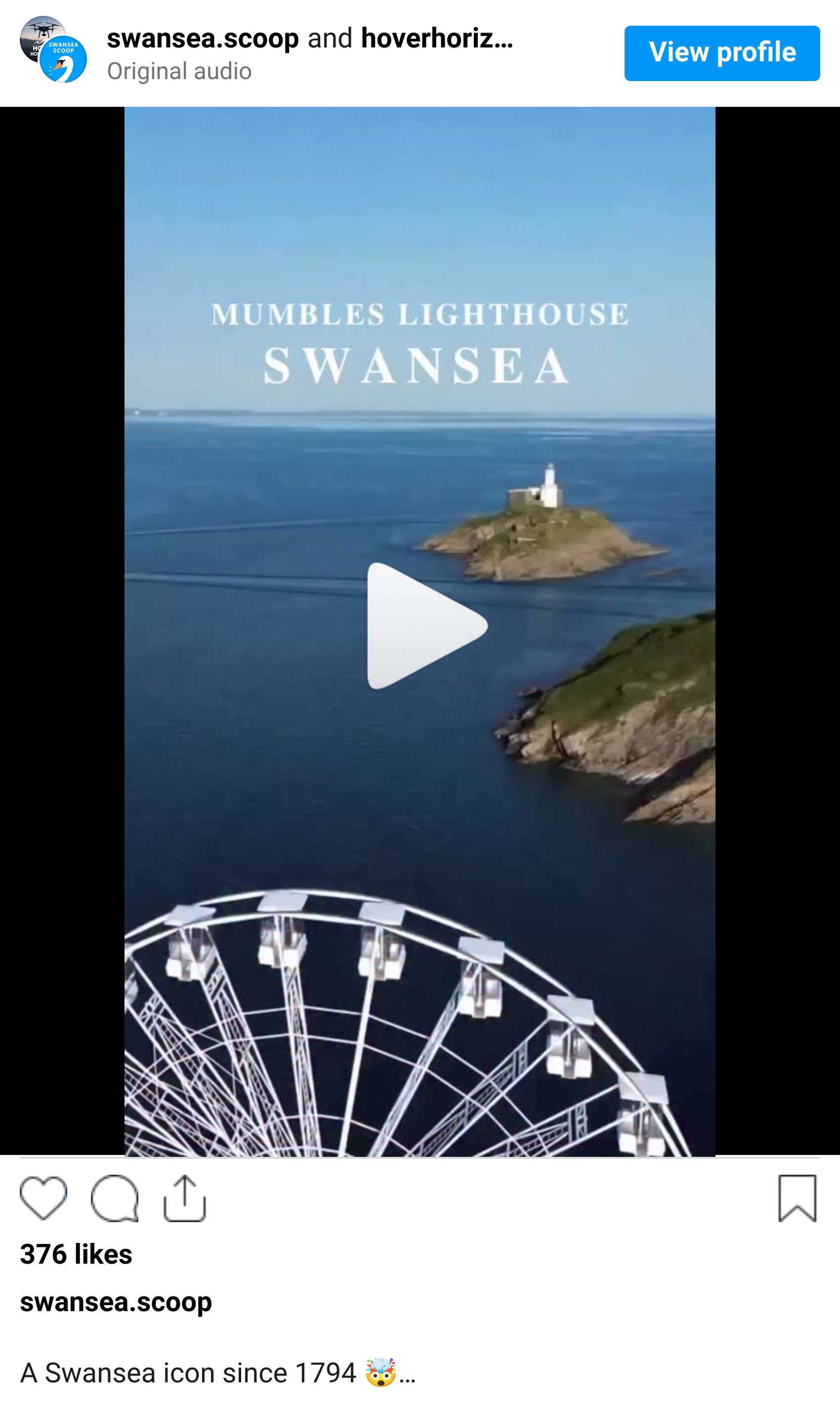
For the first 75 years after it was built, Mumbles Lighthouse was tended by the same family - a grandfather, his son, and his grandsons, each one named Abraham - until the third Abraham Ace retired in 1902 and the post passed to Jasper Williams, a keeper so associated with the mechanical foghorn installed on the lighthouse in 1908 that locals nicknamed it Jasper's Baby.
When Jasper died in 1914, his nephew John Thomas took over, with a young Charlie Cottle joining the team. By 1921, when the Great Western Railway took over Swansea Docks and inherited the lighthouse along with everything else, Charlie was its keeper - the last person who ever held the post.
Life on the island
The life of a lighthouse keeper was not an ordinary one. Charlie lived on the mainland and waded or rowed across to the lighthouse at low tide, but when the weather turned bad he could be stranded on the island for days at a time tending the oil-powered light - sometimes for the better part of a week - with no way back.

On calmer days, visitors would make the trip across for the novelty of enjoying a cup of tea with a view of the bay; on worse ones, Charlie and his colleague Joseph Hunt were entirely on their own, along with a black cat named Mackie - named, his grandson Tony Cottle later recalled, because he used to swim for mackerel.
Charlie was not a man who seems to have found the job particularly dramatic, which perhaps made him well suited to it.

Beyond the light itself, he and Joseph kept the small motor that powered the foghorn in order, managed the stores and kept a log of every ship that passed up and down the Channel.
The coastguard as we know it didn't exist during Charlie's tenure, so he also served as lookout for the whole stretch of coastline, watching for ships in distress and warning them away from the Mixon Sands and Cherrystone Rock. When a ship became stuck in the channel between the island and the headland one day, all 600 men on board had to be evacuated onto the island, whose buildings normally only had room for about 20. His grandson Tony Cottle remembered it with some understatement: "Six hundred must have been a squeeze of penguin proportions."

Charlie had a fondness for fog, because fog meant the foghorn, and the foghorn meant extra money. Every time he pulled it, Tony recalled, he'd say the same thing: "Shoes for the children!" One foggy night he spotted something wrong with the light, climbed up to investigate, and found a man interfering with it. He dragged him back down, and the matter ended up in court.
In another quirk of his character, Charlie was said to speak in the old Gower dialect - a centuries-old strain of English that had survived in the peninsula long after it disappeared elsewhere, where "thee" and "thou" were still everyday words. It apparently puzzled some of his English visitors considerably - but he didn't seem to mind that either.
The last keeper
In 1934 the lighthouse was partially automated, and by 1936 Charlie Cottle's services were no longer required - displaced, as one newspaper article put it, by an 'automatic machine.' The light had already been made to flash by a new mechanism fitted in 1905, and now even the need for a keeper was gone.

Swansea Docks in the 1930s | Credit: Swansea and Port Talbot Docks History
Charlie found work afterwards at Swansea Docks with the Great Western Railway, the same company that had owned the lighthouse, while the island's keeper cottages and small chapel were left to fall into disrepair - and eventually demolished in the 1960s.
When Charlie finished at the lighthouse, he was 61 years old and had been its keeper for 22 years. The end of his tenure was considered remarkable enough that the Daily Sketch - at the time one of Britain's biggest-selling national tabloids - devoted nearly two pages to the story - not because the job had been dramatic, but because he represented a vanishing profession and the final link in a chain of human presence on that island stretching back 140 years.

In Town Tonight was simulcast on BBC TV towards the end of its run | Credit: Wikipedia
The following year, Charlie was invited to London to share his story on In Town Tonight, one of the most popular programmes on BBC Radio, broadcast on Saturday evenings to millions of listeners across the country.
It was his first time in the capital (he had not been further than Cardiff in the 20 years prior), and on the way in, he encountered the wonder of a modern escalator. Recalling it, he told the host: "For over 20 years, I've walked up and down 72 stairs in the lighthouse, and during the midnight watch, when a man's vitality is at its lowest, that's no fun. The first time I stepped on the moving stairs I almost fell. I didn't know how to manage them. I'd like to have seen them in my lighthouse, though. I'd have known what to do with them there."
He also spoke about the war - watching ships blow up in Swansea Bay from the island, 500 yards from the shore; the keepers' families sent back to the mainland when hostilities broke out; and the men left behind on their own and reduced at one point to their last tin of bully beef and a few biscuits.
Remembering Charlie
92 years after Charlie left his post at Mumbles, its light still warns sailors away from the Mixon Sands and Cherrystone Rock, as it has done for more than two centuries. Today it is a Grade II listed building and one of the most photographed landmarks in Swansea.
So, the next time you find yourself looking out across Swansea Bay towards that lighthouse, spare a thought for Charlie Cottle - the man who kept it for 22 years, the last person who ever did - and whose name most people in Swansea have never heard.
I’ll catch you on Sunday!
Andrew.
Support the Scoop 💌

Enjoy the Swansea Scoop in your inbox each week?
Help keep us going with a monthly contribution (just £2) or a one-off tip via Buy Me a Coffee (no sign up required).
It’s quick and easy to do and every bit of support helps us stay independent, local, and free to read.
Big thanks to our 102 supporters so far, including the most recent all-round good egg, an anonymous new member! 🙏

✅ Was this email forwarded to you? Sign up
📧 Want to advertise your business to our audience of over 10,000 newsletter subscribers and 75,000+ on social media? Reply to this e-mail and we’ll be in touch!
Sources:
Primary archive documents (British Library Newspaper Archive)
South Wales Evening Post, July 6, 1994 — "Charlie was the last of the lighthouse line"
South Wales Evening Post, July 25, 1934 — Mumbles Funeral notice
South Wales Evening Post, December 3, 1935 — Gossip of the Day
Herald of Wales, December 7, 1935 — "Lighthousekeeper 'In Town'"
Belfast Telegraph, November 8, 1934 — "A Value Replaces Two Men"
South Wales Daily Post, December 13, 1930 — "Rescued in Lighthouse Boat"
Western Mail, June 25, 1935 — "Mumbles Light Tells Its Tale"
South Wales Daily News, January 20, 1916
The Herald, September 1, 1923
Online sources
A History of Mumbles — Charlie Cottle, Last Mumbles Lighthouse Keeper by Carol Powell: https://sites.google.com/site/ahistoryofmumbles/author-collections/articles-by-carol-powell/charlie-cottle-last-mumbles-lighthouse-keeper-by-carol-powell
A History of Mumbles — Keepers of the Light by Carol Powell: https://sites.google.com/site/ahistoryofmumbles/author-collections/articles-by-carol-powell/keepers-of-the-light
A History of Mumbles — Tony Cottle Lays His Last Letter by Jill Forwood: https://sites.google.com/site/ahistoryofmumbles/tony-cottle-lays-his-last-letter-by-jill-forwood
The Story of Mumbles — Charlie Cottle: https://www.storyofmumbles.org.uk/get-involved/uncategorized/charlie-cottle-the-last-mumbles-lighthouse-keeper
Gower Hidden History — Mumbles Lighthouse: http://gowerhiddenhistory.blogspot.com/2016/10/colourful-past-of-coastline-icon-and.html
Wikipedia — Mumbles Lighthouse: https://en.wikipedia.org/wiki/Mumbles_Lighthouse
Association of Lighthouse Keepers — Last Keepers: https://alk.org.uk/keepers/
Archives Hub — Charlie Cottle biographical film, 1934 (Peter Hall collection, ref D/D Z 717/144): https://archiveshub.jisc.ac.uk/search/archives/4813dbf3-c837-3b12-91a1-3134f071ad25?component=5adec8f7-2b2c-3e76-ad2b-c362978c4925
Charlie Cottle Last Mumbles Lighthouse Keeper 1934 — YouTube: https://www.youtube.com/watch?v=gaYeb8xI_Ds