
Looking for local advertising that really works? Sponsor the midweek Swansea Scoop to reach over 11,500+ people every week. Learn more and get in touch.
Every day, dog walkers, cyclists and joggers pass it without a second glance - a giant steel arch propped up on the seafront cycle path between Victoria Park and Swansea Bay.
The original Swansea Slip Bridge was taken down nearby more than twenty years ago and never put back, despite a dedicated group of residents campaigning for its return.
To understand why a footbridge can still provoke this much loyalty, you have to go back more than a century to a time when this stretch of sand was one of the busiest seaside resorts in Wales.
This week, we share the story of Swansea’s Slip Bridge.
P.S. Know someone else who’d enjoy the Scoop? Please forward this email to them and ask them to subscribe here 🙂
The busiest beach in Swansea

Crowds arrive at The Slip on trams from High Street to head to Mumbles or visit the beach | Credit: The Return of Swansea Slip Bridge
Long before Swansea Slip Bridge was built, the beach at St Helen's was already drawing crowds. By the eighteenth century, this stretch of sand was already known locally for bathing, and later for markets and travelling entertainment.
Decades later, families could step onto a tram in the town centre and be on the sands within minutes - the Slip was where the Mumbles Railway met the town tramway, creating a direct route from the heart of Swansea to the beach.
At a time when few families owned a car, the wide-open beaches of Gower a few miles further on were out of reach for most. For thousands of people living in the town's crowded streets, it was the closest thing they had to a seaside holiday - with families escaping the noise and smoke of an industrial town still at the height of its power.
Old photographs show bathing machines lined up along the beach, allowing swimmers to change before heading into the sea, with beach huts standing nearby and donkeys carrying children across the sand. Tea rooms overlooked the bay, and vendors sold refreshments to day-trippers making the most of a fine afternoon.

Welsh catering entrepreneur, RE Jones, leased the two large seafront arches of The Slip Bridge, serving teas, snacks and ice creams (1930) | Credit: The Return of Swansea Slip Bridge
The crowds could be enormous. When Swansea Corporation later justified building the bridge, councillors spoke of the "tens of thousands" who gathered around the Slip and Swansea Baths on Bank Holidays and summer weekends, with the roads and railway lines they had to cross, creating dangerous bottlenecks as people poured towards the sands.
Even Dylan Thomas chose this beach as the setting for the opening of his short story One Warm Saturday - a stretch of sand that, decades before Mumbles became the name most people now associate with Swansea's seaside, was already the one everybody knew.
A magnificent structure

Opening of the Slip Bridge, October 1915 | Credit: The Return of Swansea Slip Bridge
By the early 1910s, Swansea had a problem. The Slip had become so popular that simply getting to the beach was dangerous - visitors had to cross busy roads and railway lines to reach the sand, and the bottlenecks were bad enough to worry both councillors and the town's Chief Constable, Captain Colquhoun, who lobbied alongside Alderman Dan Jones for a safer solution.
Swansea Corporation's answer was a steel footbridge, built between 1914 and 1915 at a cost of £4,457 - a considerable sum at the time, with the ironwork supplied by Rees and Kirby of nearby Morriston. The timing could hardly have been better: the season just before it opened had been one of the busiest the sands had ever seen.

A photo taken from the steps of the Slip Bridge in the 1920s | Credit: The Return of Swansea Slip Bridge
When Alderman J. H. Lee declared it open in October 1915, he called it a magnificent structure - expensive, but one he was sure every ratepayer would be proud of. The vice-chairman of the Parks Committee, G. Hemmings, speaking as the representative for St Helen's Ward, said it gave him “one of the greatest pleasures of his life” to see an end to the dangerous congestion at the old crossing.
Not everyone agreed it had been worth it. The Mayor used his speech to take aim at the "croakers" who thought the Corporation wasteful, recalling people who had asked what earthly use the new bridge served and insisting they'd have grumbled about anything Swansea built. He pointed instead to the tens of thousands who crowded dangerously close to the Baths on Bank Holidays - and said he hoped this bridge was only the beginning, the first step towards a pavilion and a pier reaching out into the bay.
The long goodbye

Helter Skelter at the Slip Bridge | Credit: The Return of Swansea Slip Bridge
The Mumbles Railway closed in 1960, taking with it the direct route from Swansea town centre to the sands that had helped make the Slip what it was. Around the same time, rising car ownership meant families no longer needed to stay close to home for a day out - Gower and Mumbles were now just a short drive away.
Another shift came in the late 1970s and into the 1980s, when package holidays to Spain and the Mediterranean became affordable for ordinary working families for the first time, and the traditional British seaside break - the very thing the Slip had been built around - began to fade nationwide, not just in Swansea.
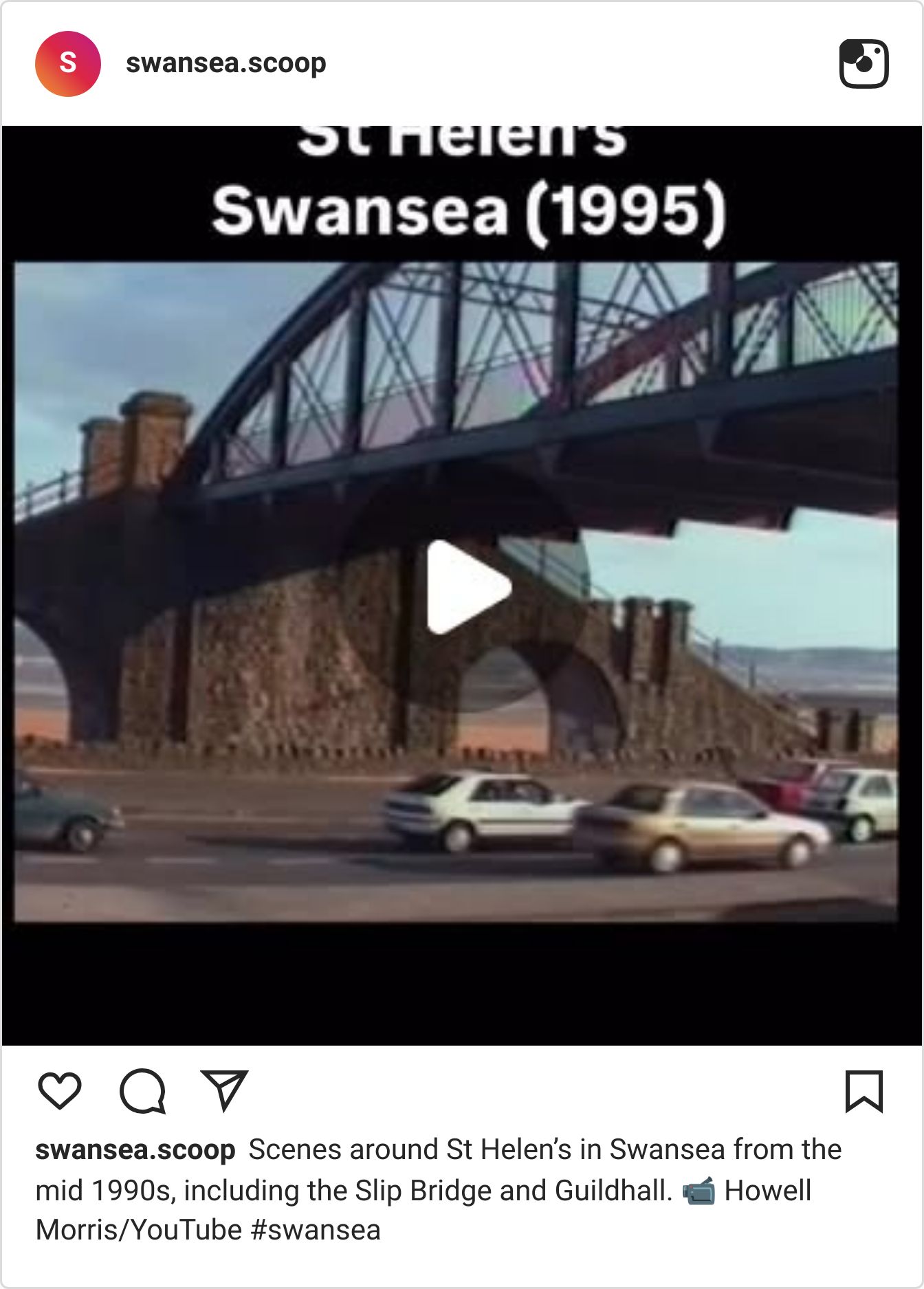
Yet it didn't empty overnight. Commenting on footage of the bridge from 1995 shared by us on Facebook, locals still remembered buying ice cream from a café tucked beneath the arches and spending afternoons on swing boats that once stood on the sand nearby. One commenter wrote that her mother used to sit on the bridge for hours as a girl, looking out across the bay. One of six children growing up in nearby prison officers' quarters, she found it was one of the few places
The bridge nobody can let go

The Slip Bridge is removed | Credit: The Return of Swansea Slip Bridge
In 1993, the council spent nearly £40,000 repainting the bridge gold and black, calling it "a piece of Swansea's history" they wanted to bring to people's attention. A decade or so later, it was gone.
The bridge was taken down in 2005, initially just to be checked over - but it quickly became clear the removal might be permanent. The stone abutments on either side of Oystermouth Road were kept in place, partly in the hope they might one day house toilets or a café, while the span itself was moved down the road to Swansea's Recreation Ground, where it has sat ever since.

Proposed design for a new Slip Bridge development (2022) | Credit: Swansea Council
Putting it back turned out to be its own problem. A council assessment put the cost of reinstating the bridge at £700,000, with a further £250,000 needed for maintenance over the following 10 to 15 years. Without listed status to protect it, there was little to stop the council simply leaving it where it lay.
Plenty of Swansea structures have come and gone without anyone organising to bring them back, but several campaign groups formed to save the Slip Bridge - including Friends of Swansea Slip Bridge, the Swansea Slip Bridge Support Group, and The Return of Swansea Slip Bridge - securing repeated, if inconsistent, signs of support. Council leader Rob Stewart gave them his "unequivocal support" in 2018, and the council confirmed again in 2022 that it had set aside nearly £140,000 to help fund early-stage plans for a replica span, café and new sports facilities.
Never really gone

The Slip Bridge today
When we shared that old footage of the bridge on Facebook, amongst the memories, comments calling for it to be put back, ran into the hundreds - more than two decades after it came down.
Stand on the seafront today and it's hard to imagine the crowds that once gathered here - the donkey rides, the tea rooms, the bathing machines, the trams arriving packed with day-trippers from town.
Most of it has disappeared so completely that you'd never know it existed at all. Yet somehow, passion the old Slip Bridge still refuses to fade away. Perhaps that's because, for many people, it isn't really a bridge they miss - it's a Swansea that no longer exists, and the memories of summers spent beside it.
I’ll catch you on Sunday!
Andrew.
Support the Scoop 💌

Enjoy the Swansea Scoop in your inbox each week?
Help keep us going with a contribution via Buy Me a Coffee - just £2 per month, £20 per year, or a one-off tip.
It’s quick and easy to do and every bit of support helps us stay independent, local, and free to read.
Big thanks to our 111 supporters so far, including the recent all-round good eggs, EJ, SM, Jacky, and an two anonymous tippers! 🙏

✅ Was this email forwarded to you? Sign up
📧 Want to advertise your business to our audience of over 11,000 newsletter subscribers and 80,000+ on social media? Reply to this e-mail and we’ll be in touch!
Sources:
Slip Bridge Opening Day Photo - The Return of Swansea Slip Bridge: https://www.facebook.com/photo?fbid=850247480537330&set=a.451620680400014
Welsh catering entrepreneur, RE Jones, leased the two large seafront arches of The Slip Bridge, serving teas, snacks and ice creams - The Return of Swansea Slip Bridge: https://www.facebook.com/photo?fbid=570279148534166&set=a.451620690400013
Swing Boats at the Slip Bridge - The Return of Swansea Slip Bridge: https://www.facebook.com/photo/?fbid=2172143552954862&set=a.451620680400014
The Slip Bridge is removed - The Return of Swansea Slip Bridge: https://www.facebook.com/photo?fbid=2166884633480754&set=pb.100066562585191.-2207520000
Helter Skelter at the Slip Bridge - The Return of Swansea Slip Bridge: https://www.facebook.com/photo/?fbid=1946608062175080&set=pb.100066562585191.-2207520000
Crowds arrive at The Slip on trams from High Street to head to Mumbles or visit the beach - The Return of Swansea Slip Bridge: https://www.facebook.com/photo.php?fbid=1261027477399812&set=pb.100066562585191.-2207520000&type=3
A photo taken from the steps of the Slip Bridge in the 1920s - The Return of Swansea Slip Bridge: https://www.facebook.com/photo.php?fbid=840744169428147&set=pb.100066562585191.-2207520000&type=3
Proposed design for a new Slip Bridge development (2022) - Swansea Council: https://swansea.gov.uk/article/13989/Council-set-to-continue-support-of-Slip-Bridge-group