Good morning, Swansea!
In January 1913, three Swansea sailors decided they were going to do what challengers around the world had failed to achieve: keep Harry Houdini tied up.
Their plan involved a seven-foot plank, a broomstick and a web of rope based, they claimed, on an old punishment for mutinous sailors. Houdini accepted the challenge, to be carried out in front of an audience at Swansea's Empire Theatre.
By the night of the performance, the South Wales Daily Post reported crowds so large that traffic outside was almost brought to a standstill.
This week, we're looking back at the night Swansea tried to outsmart the world's most famous escape artist.
Houdini Before Swansea

Houdini arrived in Swansea at the height of his fame, but also at a point when simply escaping from handcuffs was no longer enough to wow an audience. The Hungarian-American escapologist had spent years turning himself from a struggling magician into an international star by letting police, locksmiths and members of the public lock, chain and restrain him — then finding increasingly spectacular ways out.
And Swansea caught him just as he was raising the stakes again. The week before, at Cardiff's Empire Theatre, Houdini had been performing his new Water Torture Cell, lowered upside down into a tank of water with his ankles locked above him — and telling the Western Mail that Cardiff was "the birthplace of my latest and greatest trick," inspired, he said, by a newspaper illustration of Chinese torture methods he'd bought in the city two years earlier.
From Cardiff he travelled straight to Swansea for six nights at its Empire Theatre on Oxford Street, opening on January 13th, 1913. The theatre, opened in 1900, was one of the town's big variety venues and part of the circuit that brought leading entertainers on their tours of the UK - it survived until 1960, when it was demolished.
Challenge Houdini

Part of Houdini's success was making each stop on tour feel like a local contest. Rather than simply repeating the same escape every night, he invited members of the public to come up with their own ways of trapping him. Surviving handbills from his career record challenges involving everything from straitjackets and packing cases to mailbags and specially made restraints.
It worked because local challengers had something to prove, newspapers had a story to follow, and audiences turned up hoping their town might finally be the place where Houdini met his match.
In Swansea, that challenge came from three experienced seamen: Captain Henry Barnes, who had spent 35 years at sea, Bernard Westenborg, with 10 years' experience, and Edward John Barrett, with 16. Their original red-printed handbill, dated 13 January 1913, still survives today.
"We the undersigned experienced Seamen, hereby challenge you to escape," it began, before describing a method of trussing they said had been used "in olden days" to restrain troublesome sailors.
Houdini accepted. But what Barnes, Westenborg and Barrett had devised was considerably more elaborate than simply tying his hands together.
Swansea's Attempt
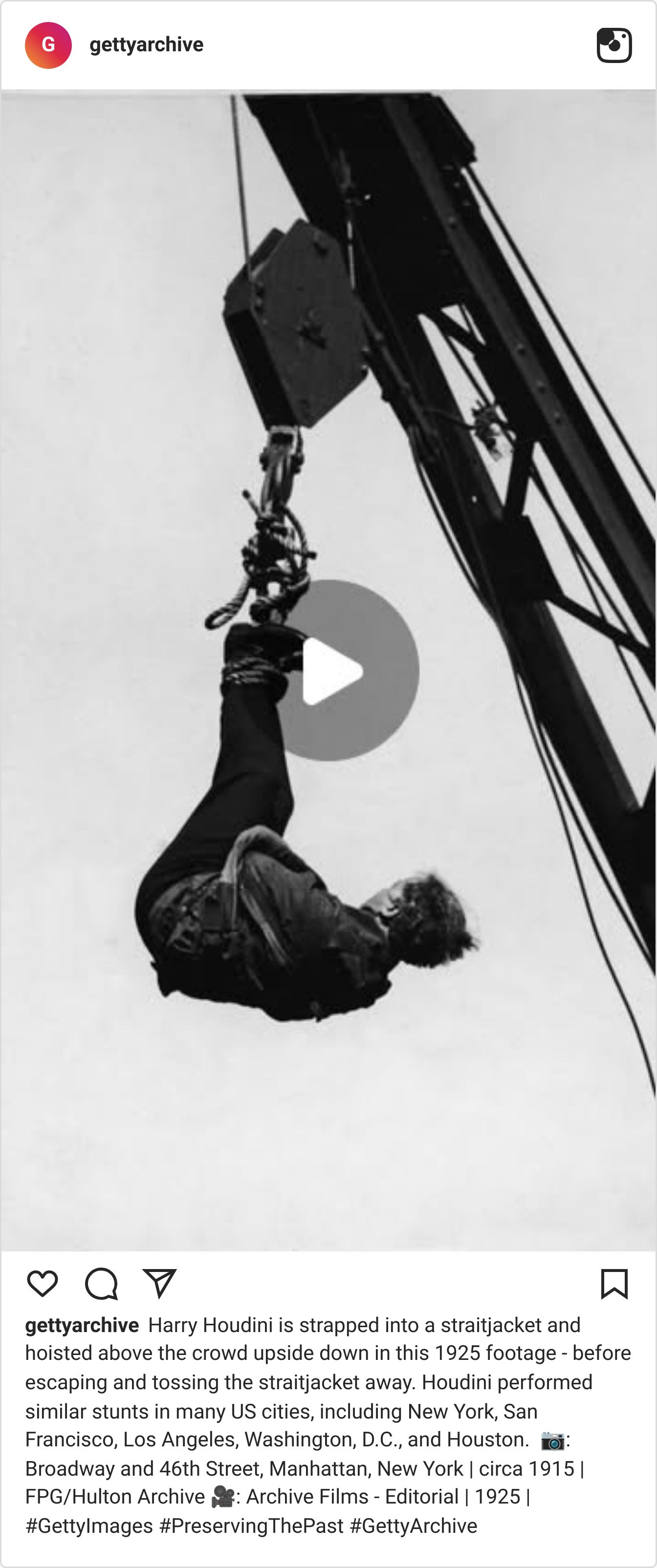
Houdin’s wrists were to be tied to a broomstick placed behind his knees, then he was to be lashed feet-upwards to a seven-foot plank and bound again with rope - the whole ordeal carried out in full view of the audience.
By Friday night, the Empire was packed. The Cambria Daily Leader reported huge crowds gathering in Oxford Street long before the performance, with some unable to get inside. "My reputation is at stake," Houdini told one of its reporters as the curtain rose.
Then came an unexpected complication. When Houdini examined the ropes, he discovered they contained wire - something he said had not been part of the challenge. Rather than refuse, he agreed to settle it with a toss of a coin. He lost.
The sailors bound him in front of the audience and, after what the paper described as around a quarter of an hour of "apparently hopeless struggling", Houdini threw off the restraints to a thunder of applause. Leaving the stage afterwards, Houdini admitted it had been "one of his most trying ordeals".
Houdini Returns

The sailors hadn't put Houdini off Swansea. He returned to the Empire in March 1914, when a fresh challenge appeared in print under the headline "Houdini Defied." A three-man committee wrote to Houdini offering to have a large cane travelling hamper specially built by the Swansea and South Wales Institution for the Blind, fitted with padlocks, then locked and roped shut around him. "As there are no boards to manipulate as in a packing case," it wrote, "it is doubtful if you will accept this challenge." Houdini did accept, and the attempt was set for the second performance on Friday evening, March 6th.
By February 1920 he was back once more - now not only an escape artist but a film star.
But it’s Houdin’s first performance at the Empire that feels most poignant - Swansea’s chance to trap theescapologist and make headlines around the world - and those three sailors very nearly succeeded.
I’ll catch you on Sunday!
Andrew
Support the Scoop 💌

Enjoy the Swansea Scoop landing in your inbox every week?
Help us keep the Scoop independent, local, and free to read with a monthly contribution of just £2 or a one-off tip via Buy Me a Coffee (no sign-up required).
A big thank you to our 126 supporters so far – including our latest annual supported, Cai Ladd!

Sources: Western Mail (Cardiff Water Torture Cell coverage, incl. research by John Cox, Wild About Harry); wildabouthoudini.com; davidde-val.com (Houdini UK Tours); Sotheby's (13 January 1913 Swansea challenge handbill, catalogued and reproduced); Cambria Daily Leader, 18 January 1913 (via Papurau Newydd Cymru); Harry Ransom Center, University of Texas (Houdini papers, 1920 Swansea poster)